0


Key Takeaways
- Belonging vs. Winning: Challenge coins symbolize membership and shared identity; medallions signify formal placement and victory.
- Portable vs. Displayed: Coins are designed for pocket-carry and personal exchange, while medallions are designed for ribbons and public display.
- Symbolic Value: Challenge coins rely on limited distribution and military-style tradition to build long-term collectibility.
Choosing between a challenge coin and a medallion matters when you want the right symbol for recognition, branding, or commemoration. Challenge coins focus on affiliation and shared identity, while medallions highlight achievement, placement, or formal recognition.
We see challenge coins used by military units, corporations, and event teams to mark membership or milestones that people carry and share. Medallions usually appear in awards, competitions, or ceremonies where display, ranking, and presentation take priority.
As a custom promotional products company, we help organizations decide which format fits their purpose, budget, and design goals. As you explore definitions, uses, and customization options, you will see how the right choice can strengthen recognition and make custom ordering simple when you are ready for a quote.
Defining Challenge Coins and Medallions
Both items serve recognition and branding, but they differ in purpose, history, and how people use them. Understanding these differences helps you choose the right format for your organization, event, or campaign.
Origins and History
Challenge coins trace back to military traditions, where units used small coins to show membership and build camaraderie. Service members carried them to confirm affiliation or mark achievements. Over time, police departments, fire stations, corporations, and nonprofits adopted challenge coins for internal recognition and morale.
Medallions developed from award and commemorative practices tied to sports, academic honors, and public ceremonies. Organizations typically present them for a specific accomplishment or milestone. Unlike challenge coins, recipients do not usually carry medallions daily or use them in informal traditions.
At Custom Pins Now, we see both formats used outside their original contexts. Companies now commission challenge coins for onboarding or anniversaries, while medallions appear at corporate awards nights and fundraising events.
Key Characteristics
The purpose often defines the format more than the size.
Challenge coins typically:
- Represent membership, affiliation, or shared experience.
- Get handed directly from a leader or peer.
- Encourage personal connection and long-term keeping.
Medallions typically:
- Recognize a specific achievement or placement.
- Get awarded during a formal ceremony.
- Focus on public acknowledgment rather than daily carry.
Challenge coins act as symbols of belonging. Medallions act as proof of accomplishment. When clients ask us which to choose, we start with one question: Do you want people to carry it, or display it?
Physical Design Elements
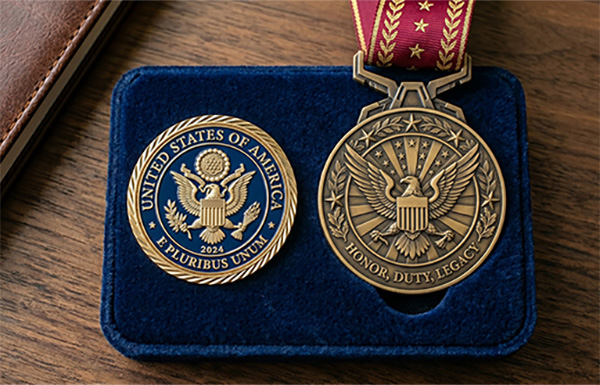
Design reinforces how people use each item. Challenge coins usually fit in a pocket and feature detailed designs on both sides. Many include unit insignia, mottos, or dates tied to an event or mission.
Medallions often run larger and emphasize visibility. They may hang from ribbons or sit in presentation cases. Designs focus on clarity from a distance, such as placement text or event names.
Comparison of Physical Features:
- Typical size: Challenge coins (1.5–2 inches) vs. Medallions (2–3+ inches).
- Carry style: Challenge coins (pocket or wallet) vs. Medallions (ribbon or display).
- Design focus: Challenge coins (symbolism and detail) vs. Medallions (readability and formality).
We help teams customize thickness, finishes, and edge styles for both. If you already have a concept in mind, we can turn it into a production-ready design and get you a fast quote.
Primary Purposes and Uses
Challenge coins and medallions serve different roles even when they look similar at first glance. The difference comes down to how people use them, when they present them, and what they represent to the recipient.
Recognition and Commemoration
Organizations use challenge coins to recognize participation, service, or affiliation rather than rank or placement. Military units, police departments, and companies often hand them out during promotions, unit visits, or milestone events. The coin marks inclusion and shared experience, not competition.
Medallions focus on formal achievement. Sports leagues, academic institutions, and corporate award programs use them to mark wins, completions, or rankings. They often include dates, titles, or placement details and appear at scheduled ceremonies.
Key differences in use:
- Timing: Challenge coins are often informal or spontaneous; medallions are for planned ceremonies.
- Meaning: Challenge coins represent membership or contribution; medallions represent measurable achievement.
- Distribution: Challenge coins are handed personally; medallions are awarded publicly.
If you want flexible recognition that works year-round, challenge coins offer more options. We often help teams design coins that match their mission and budget, then quote them fast so they can move forward without delays.
Traditions and Symbolism
Challenge coins carry strong traditions, especially in military and public service settings. Members keep them on hand, exchange them as signs of respect, and sometimes use them to confirm group affiliation. The symbolism centers on identity, trust, and belonging.
Medallions rely less on tradition and more on visual authority. Ribbons, neck chains, and standardized sizing make them easy to recognize from a distance. The symbolism stays clear and literal: accomplishment, rank, or victory.
Both items communicate value, but in different ways:
- Challenge coins emphasize connection and pride.
- Medallions emphasize status and outcome.
When symbolism matters as much as appearance, custom design choices make the difference. We work with organizations every day to turn those ideas into tangible products, starting with a simple free quote.
Collectibility and Customization
Collectibility depends on how you design, distribute, and limit each piece. Customization choices also affect cost, turnaround time, and how recipients perceive long-term value.
Customization Options
Challenge coins support dense, detailed designs on both sides. We often add edge text, sequential numbering, cutouts, and multi-level 3D relief to highlight units, milestones, or events.
Medallions focus on presentation and wearability. They usually feature larger faces, ribbon attachments, and simpler edge treatments, which work well for sports, academic awards, or public ceremonies.
Feature Breakdown:
- Sides: Challenge coins are double-sided by standard; Medallions can be single or double-sided.
- Edge detail: Challenge coins feature text, patterns, or numbering; Medallions are typically minimal.
- Size range: Challenge coins (1.5–2.5 inches); Medallions (2–3 inches).
- Display: Challenge coins are handed or carried; Medallions are worn or displayed.
We help clients at Custom Pins Now choose finishes, enamel types, and packaging that fit budget and intent. Want something unique without inflating costs? We guide those tradeoffs during a free quote.
Rarity and Value
Collectors value challenge coins for limited runs and controlled distribution. Units often mint small quantities for specific missions, anniversaries, or leadership presentations, which increases perceived scarcity.
Medallions gain value through event significance rather than rarity. Annual tournaments or academic honors create consistency, but reissues reduce collectibility over time.
Key factors that influence long-term value include:
- Production quantity.
- Serial numbering.
- Event or organizational importance.
- Condition and original packaging.
Coins exchanged peer-to-peer often carry personal stories, which drives demand among collectors. Medallions anchor memories to public achievements and formal recognition.